Featured

‘Freaks’: Respecting the Performer

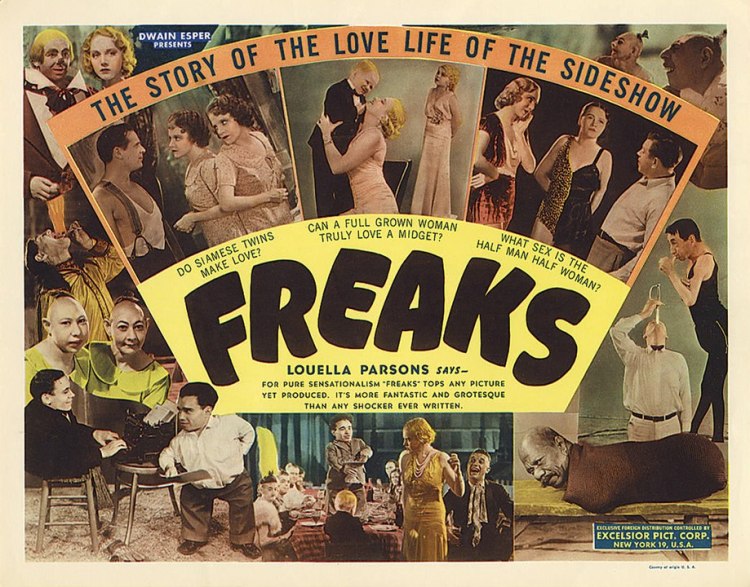
Poster for the film 'Freaks'
Poster for the film ‘Freaks’

Today, we’re going to talk about sideshow in film. There have been dozens of films and television shows to depict circuses and sideshows, but many of them take a rather ungenerous approach to the performers, either pitying them like the exploitation film Chained for Life or demonizing them like Something Wicked This Way Comes. Art imitates life: many people back when sideshows we’re still around thought the performers were monsters or dangerous. Nowadays there’s a perception that sideshow performers were nothing but poor, helpless, exploited souls who had no agency or say in the way their lives went. There is one film, however, who gave the performers the respect they deserved and managed to tell a gripping story in addition to it: Tod Browning’s Freaks.
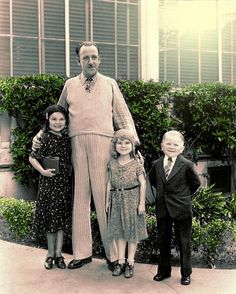
The Doll Family and Tod Browning
The Doll Family (Including Harry, right, who plays Hans in the film
and Daisy, left, who plays Frieda) and Tod Browning

Released in 1932, Freaks tells the story of a conniving aerialist, Cleopatra, and her brutish strongman lover, Hercules, who conspire to seduce Hans, the leader of the sideshow performers and a little person, away from his girlfriend Frieda, another little person, in order to get his large inheritance. Through the film, Cleopatra’s plan is discovered by the sideshow performers and to find out what happens after that, you have to watch the film. One of the many things that makes this film special is that it features many famous sideshow performers from the era: Harry and Daisy Earles (Little People), Daisy and Violet Hilton (Conjoined Twins), Johnny Eck (Legless Wonder), and Schlitzie (Pinhead). This cast is one that couldn’t be recreated. Modern medicine has made the conditions these performers have even rarer, so the cast literally irreplaceable. 

For the sideshow enthusiast, this film is a must-watch. Due to the era sideshows were popular in, not much footage of these performers exists, so it’s fascinating to see the people you read about and see in pictures come to life. There is a frankly incredible scene where Prince Randian, a performer born without arms or legs, lights a cigarette using only his lips. We get to see an armless woman drink with her toes and Johnny Eck navigate the world without legs. As old sideshow banners would say, these are feats that need to be seen to be believed, and with Freaks we get to see them. Something to note about the activities I’ve described the performers doing is that they are mundane. 

The beauty of Freaks is how mundane some of it is. We don’t see the performers doing trained acts or trying to impress a crowd. The film takes place behind the scenes of the circus, so most of what we see are the performers living their lives, not performing. None of them are locked in cages or chained up. They’re human beings doing the only jobs they’d be able to do at the time, willingly, and enjoying the community they’ve found in the show. We see them eating dinner, celebrating events, falling in love, and growing jealous. Because they’re around each other, they don’t act like they’re different or unusual, they just act like the human beings they are. They have flaws, they have hopes, they’re just regular people with unusual forms. 
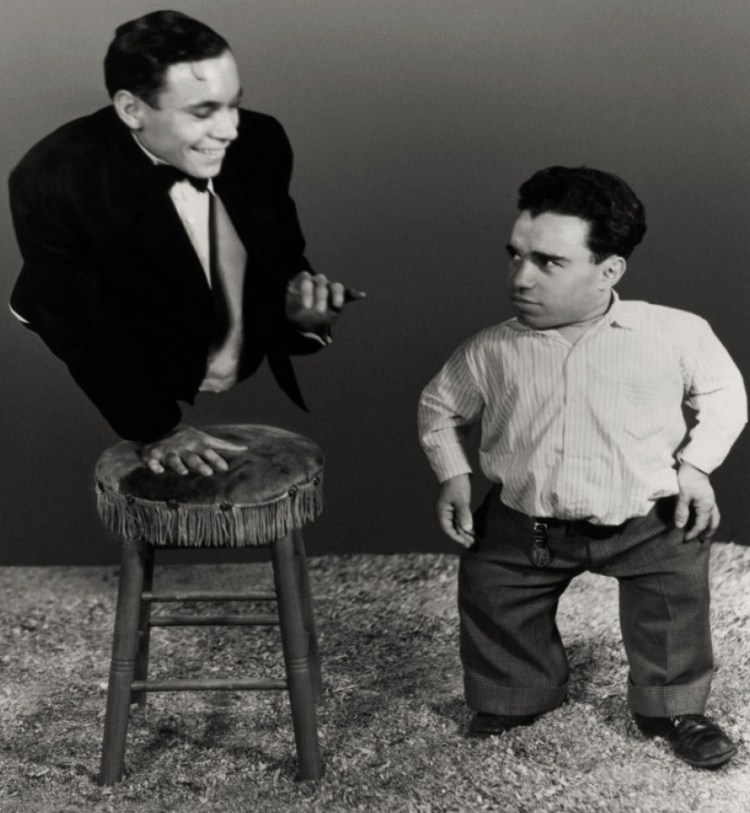
Johnny Eck and Angelo Rossitto in 'Freaks'
Johnny Eck and Angeleo in ‘Freaks’

One of the most stunning and heart wrenching scenes in the film is the wedding of Hans to Cleopatra. This is the scene most people know from this film, as it involves the famous chant: “We accept her, one of us.” The sideshow performers chant this at Cleopatra to indicate that her marriage to Hans brings her into the family that the performers have built together. As they do this, they pass around a loving cup to further cement her status in their ranks. When Cleopatra, drunk on champagne, realizes this, she becomes furious and throws the loving cup into the face of Angeleo, the little person who had been passing it around. She shouts at the wedding party, calling them all freaks. The look of betrayal and heartbreak on everyone’s face when the word comes out of her mouth is truly moving. 

There’s a reason I have elected to call this blog “Prodigies!” and have avoided the use of the term “freakshow” as much as possible. The people documented in the film Freaks and on this blog are anything but freaks. They’re human beings who deserve the same respect one would give to any stranger on the street. With the ending of the film, even if it makes the performers violent or cruel in it shows them protecting themselves. It gives them agency, something many popular depictions of their lives denies them. It shows them taking action for themselves. They aren’t inhuman monsters or pitiable creatures, they’re human beings who are taking revenge on those who treat them poorly.
The Hairy Folk: Hypertrichosis in the Sideshow

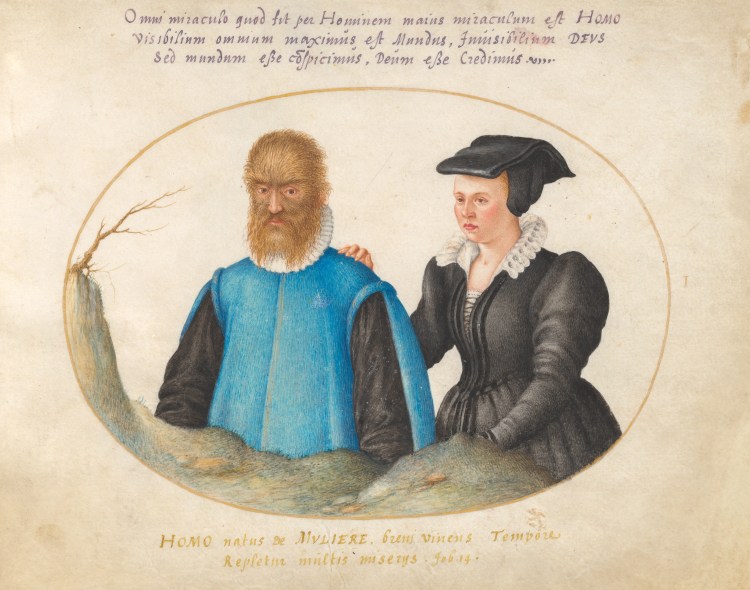
A painting of a man with hypertrichosis next to a woman
Joris Hoefnagel, Animalia Rationalia et Insecta (Ignis)- Plate I

The sideshow was a place where people could see all kinds of rare disorders and deformities on display. From achondroplasia to microcephaly to neurofibromatosis, all kinds of conditions were present, albeit with less technical names for the performers (dwarves, pinheads, and knotty men respectively). One disorder was unique in that it produced two different kinds of sideshow performers, both incredibly valuable, but diversely marketed: hypertrichosis. Hypertrichosis is a disorder characterized most generally by excessive or unusual hair growth. There are five types of hypertrichosis, but for this article, we’re mainly focused on two: congenital hypertrichosis terminalis (CHT) and hirsutism. CHT is also known as “werewolf syndrome” and gave the sideshow their hairiest performers, like lion faced men and dog faced boys. Hirsutism only affects women and is the condition that gives bearded ladies their beards. We’re going to discuss CHT first. 

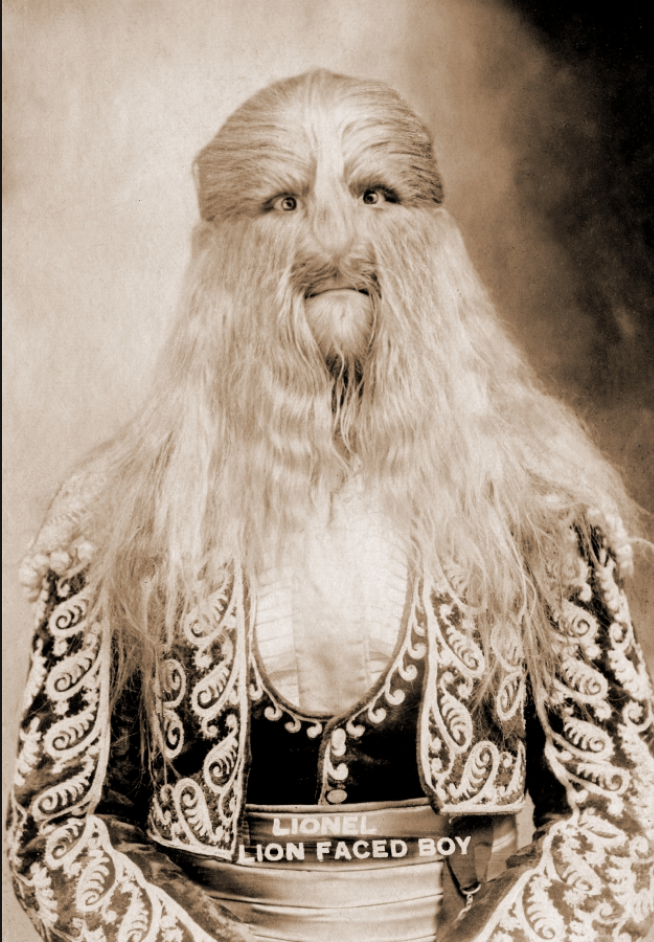
A portrait photograph of Lionel the Lion Faced man in a brocade jacket
Lionel the Lion Faced Man

CHT is a genetic disorder caused by a contiguous gene deletion. If you recall my last blog post, you may remember that before the causes of disorders like these were discovered, it was thought that a shock to a pregnant woman affected how the baby would look after being born (Hence why Chang and Eng were banned from France). This tactic was often used to explain and sensationalize sideshow performers. Lionel the Lion Faced Man often had a pamphlet accompanying his exhibition explaining that he had such excessive hair growth because his mother saw his father mauled by a lion before he was born. Being a genetic disorder means CHT often runs in families, and sometimes families would be exhibited together, such as the Sacred Hairy Family of Burma, who were exhibited in the Burmese court for five generations until it was overthrown by the British in 1885. CHT begins as soon as the child is born and leads to excessive hair growth all over the body except the palms, soles of feet, and mucous membrane. Surprisingly, it also causes dental issues, including missing teeth and delayed eruption of teeth, meaning the people with so-called werewolf syndrome often couldn’t bite into an apple, let alone human flesh. 

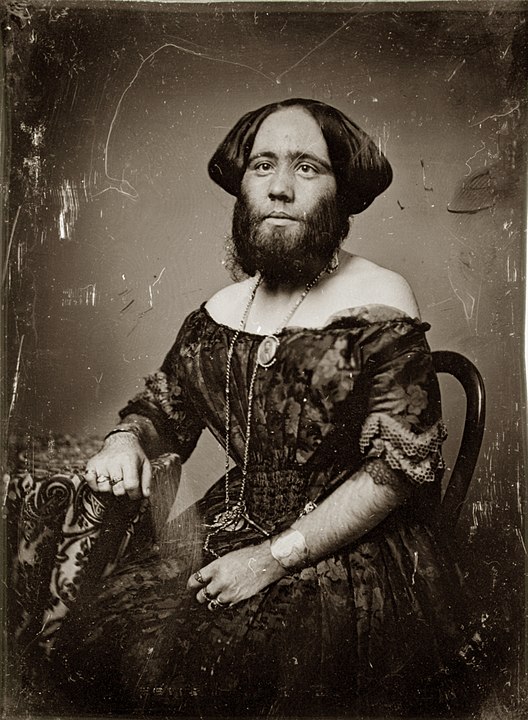
Josephine Clofullia reclining in a chair
Madame Josephine Fortune Clofullia

Hirsutism is much more common than CHT, affecting around 7% of women in the US. Hirsutism isn’t only facial hair growth, it refers to any excessive growth where women usually don’t grow hair, such as on the back or chest. Where CHT is a genetic condition that affects people as soon as they are born, hirsutism has variable causes. For some women, they have beards from the day they’re born, due to their faulty adrenal glands. Madame Josephine Fortune Clofullia, as an example, had a full beard by age two. For others, their adrenal glands only malfunction after a major shock to their system. Madame Baroness Sidonia de Barcsy only started sprouting whiskers after she gave birth to her son Nicu. Her tale is interesting because instead of informing her of this new development, her doctors ordered her husband to take down all of the mirrors in her house and said that no one should inform her that she had sprouted facial hair.

Hypertrichosis is essentially curable nowadays, what with laser hair removal and electrolysis, but some people with the condition still maintain and profit off of their hair. Bearded lady Vivian Wheeler, as an example, was a touring bearded lady as recently as 2010 with the Grim Bros and Hall and Christ sideshows. While this blog may cover sideshow history, it’s important to remember that people like these past performers still walk the earth, and they deserve the same respect and decency that you would give anyone else…even if you sneak a peek at them as they pass. 

Today’s main sources were Healthline.com and American Sideshow by Marc Hartzman. This is one of my favorite books of all time, I highly recommend. It’s a must-have if you enjoy sideshow history. 

A Brief History of Chang and Eng Bunker: The Original Siamese Twins

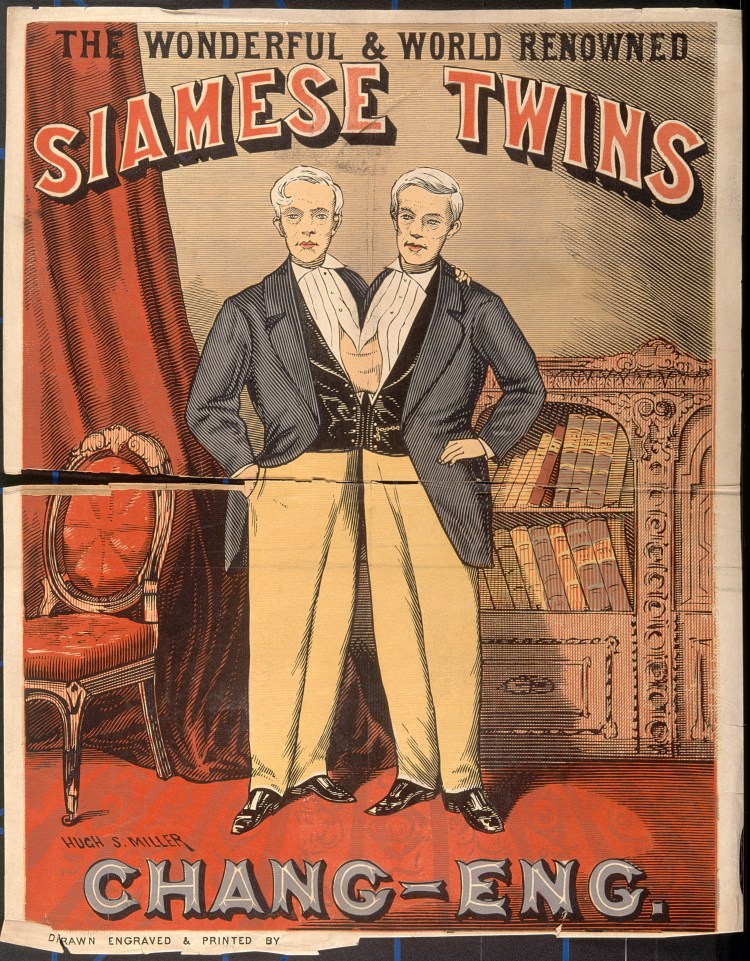
V0010478 Chang and Eng, the Siamese twins, in evening dress. Colour w Credit: Wellcome Library, London. Wellcome Images images@wellcome.ac.uk http://wellcomeimages.org Chang and Eng, the Siamese twins, in evening dress. Colour wood engraving by H.S. Miller. By: Hugh S. MillerPublished: – Copyrighted work available under Creative Commons Attribution only licence CC BY 4.0 http://creativecommons.org/licenses/by/4.0/

Have you ever wondered why all conjoined twins are referred to as “Siamese Twins”? It comes from the two men who became the quintessential conjoined twins of the 19th century, and basically all of history. Chang and Eng Bunker, the men for whom all other Siamese twins are named, were born in Siam in 1811. They were born in the small fishing village of Meklong to a family with no history of conjoined twins. Chang and Eng were named for the Chinese words for right and left, respectively. They were connected by a ligament in their chest, so they would naturally face each other. As they developed, their mother had them stretch the ligament so they would be able to do more in life. Their childhood development was difficult, but they eventually got to the point where people said they moved with the grace of partners who had been dancing together for years. The birth of the twins brought a lot of attention to the humble Siamese village, with news of their birth even reaching the king. Doctors and other interested parties came over land and sea to visit the miraculous young men. The boys had become one of the national treasures of Siam. Their fame would soon spread beyond their home country, however, they would become international stars. 

In 1824, a Scottish merchant named Robert Hunter discovered the boys while they were out swimming. They seemed eager to travel the world with him, but the Siamese government prevented their departure from the country. None of that stopped Hunter, however, who kept at the quest for years. In 1829, Hunter joined up with a business associate of his, Captain Abel Coffin. Coffin and Hunter, seeing the Siamese government’s desperation to increase relations with the west, argued that he would take the boys out of the country as a way to advertise Siam to the world. The argument worked, and the boys were taken to Boston, now billed as “the Siamese Double Boys.” They would never return to Siam.

Upon their first exhibition, the boys were tremendously successful, selling out crowded tents with seats priced as high as six dollars a seat. The average wage at that time was sixteen dollars a week, so you can tell people were eager to see the twins. Doctors also took an interest in the twins, studying the ligament that held them together. One doctor warned that the ligament was full of important nerves and veins, and that if one twin died, they would need to be separated immediately in order for the other to survive. While the original act of the twins involved displaying their body while someone lectured about them, audiences soon grew tired of that. Knowing that the shock of their condition could only get them so far (and that audiences hate lectures), Chang and Eng developed an act. They performed complex physical tasks such a turning somersaults and stretching their ligament. They also incorporated speaking into their act, as they had learned English on the boat over from Siam, and the public fell in love with their  charming personalities. 

Their act was so popular that Hunter and Coffin decided to take their act to Europe, beginning in England. The English public was enamoured of them, and their show was even attended by members of the royal family. While popular in England and the British Isles, when the men tried to take their act to Europe, they were surprised to find they were barred from entry. The French Government believed in a phenomena called “maternal impressions,” which held that if a mother saw something upsetting during pregnancy, it could affect her unborn child (this myth was later used to advertise Lionel the Lion-Faced Boy, with the story being that his mother was scared by a lion while pregnant with him). Though France rejected the well-spoken Siamese, the rest of Europe was more than happy to have them, and they travelled extensively in Europe and the United States for years after. 

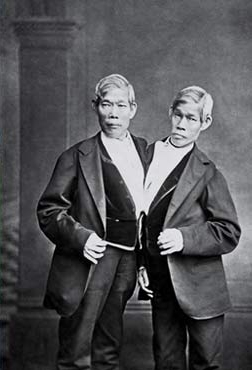
Eng and Chang in their 60s. Public domain photo.

Eventually, as the twins grew older and became more aware of the business they were in, they realized that their manager Coffin (who had bought out Hunter at this point) was taking most of their money. At the age of twenty-one, when they legally became adults, they broke off their connection with him and hooked up with the legend of sideshows, the Shakespeare of advertising, the sleazeball of the century, Mr. PT Barnum. Despite their fame and popularity, Barnum was never overly affectionate towards the twins in the same way he was with his other major successes like Tom Thumb and Joyce Heth. The twins didn’t care much for Barnum either, so they went their separate ways. The twins began touring under their own management, and that suited them just fine, having been burned by shady managers before. They toured for a few years like this, even going to Europe, but life on the road proved tiring for the almost thirty year old twins, so they decided to settle down. 

In 1839, Chang and Eng decided to settle in Wilkesboro, a small town in North Carolina. With the money they had made from performing, they bought a 110 acre farm and started life as farmers. They also became American citizens that year and formally adopted the last name “Bunker” as their own. Chang and Eng began dating in this period of their life, courting two young Quaker sisters, Adelaide and Sarah Ann. The townsfolk objected to this union, not only because of the young men’s deformity, but also because they were Asian. Despite objections from racists and bigots, Chang married Adelaide and Eng married Sarah Ann in a double wedding in 1843. 

Chang and Eng proved to be very fruitful men, fathering twenty-two children between them. In the 1850s, the twins started touring again to be able to afford to educate all of their children well. As their families grew bigger, it became evident that no one house would be able to hold all of their children. With this in mind, they built two houses on their property and split their time evenly between them, alternating every three days. Nothing was significant enough to break the three day rule, not sickness, injury, nor even the death of a child. Another problem arose in Chang and Eng’s life in the 1860s, namely the Civil War. Being wealthy, slave owning southerners, Chang and Eng were on the side of the Confederacy. This fact proved financially troubling for them, as the freeing of slaves at the end of the war left them with a greatly diminished labor force. The economic hardships forced the twins to once again work with Barnum in order to support their enormous family. They once again toured England and other parts of Europe. 

On their way back from their tour of Europe, Chang suffered a stroke, partially paralyzing him and imposing a great strain on Eng to support him. Chang became deeply depressed after this and took to drinking, and from there his health only deteriorated further. Chang passed away first, with Eng following shortly after, on January 17th, 1874. It is unknown whether or not Chang and Eng could’ve been separated by today’s modern medicine, but with medical technology as it was then, separation attempts likely would’ve killed them. 

Chang and Eng lived to be 63, an age unprecedented for conjoined twins to live at the time. Their descendants are numerous, and their legacy is perhaps one of the most persistent of any sideshow performers. They went from living on a fishing boat in Siam to being internationally famous. They met royalty, they were banned from France, they fathered twenty-two children and were married to white women, an incredible feat in the 19th century for Asian men. Truly they are some of the most incredible twins to walk the earth and their legacy should be more than a colloquialism people don’t know the origins of.

That was the biography of Chang and Eng. I got much of my information on these twins from the fantastic book Very Special People by Frederick Drimmer. It is a great read for those interested in a deep dive on a variety of performers. Catch you readers next week.

About the Author

“We are all ladies and gentlemen, and we act so. None of us are frights.”

Charles Tripp

The above listed quote is the thesis of this blog and the motto of its author. I’m Abby Adams, and I am the author of this blog. I am an undergraduate student at Washington and Jefferson College majoring in English and Communication arts. This blog is being written for a 300-level English course, but it is also being written out of a deep respect and admiration for sideshow performers. The blog’s title “Prodigies!” comes from The Protective Order of Prodigies, a conference of sideshow performers from the turn of the century which was formed to protest the use of the word “freaks” to describe sideshow performers. This blog aims to give these performers the dignity they are often denied and to provide their history to those unfamiliar. This blog will feature posts like:

  • Biographies of historic sideshow performers
  • Opinions on sideshow related media
  • Histories of famous sideshows
  • Op-eds about sideshow practices
  • And more!

Check back in for more posts as this blog goes and remember to enjoy the show!

Design a site like this with WordPress.com
Get started