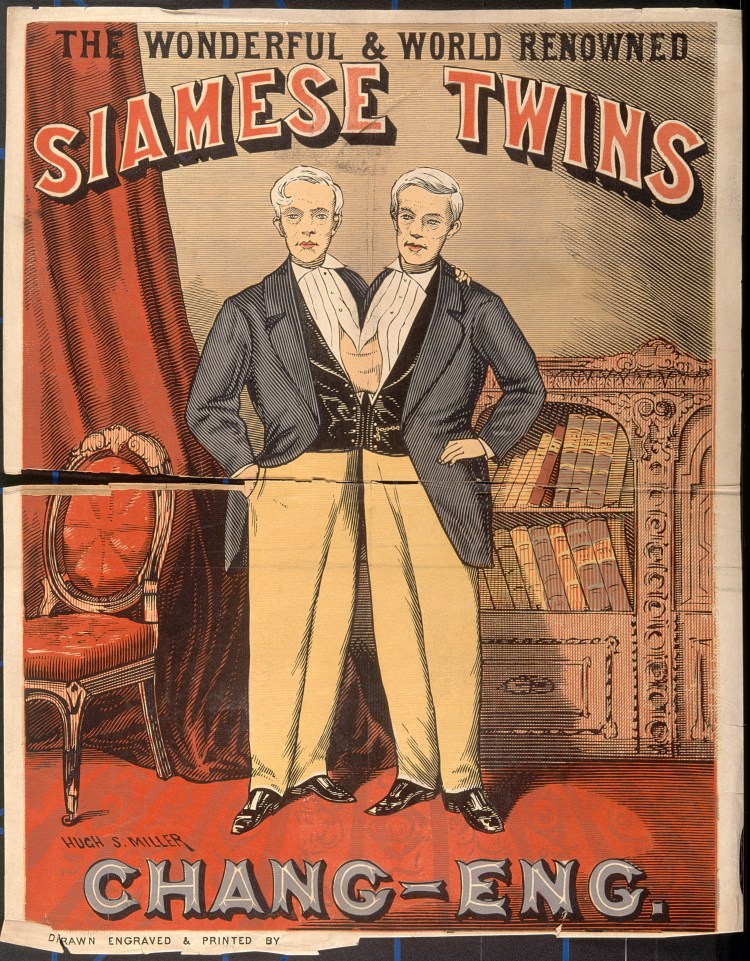
Have you ever wondered why all conjoined twins are referred to as “Siamese Twins”? It comes from the two men who became the quintessential conjoined twins of the 19th century, and basically all of history. Chang and Eng Bunker, the men for whom all other Siamese twins are named, were born in Siam in 1811. They were born in the small fishing village of Meklong to a family with no history of conjoined twins. Chang and Eng were named for the Chinese words for right and left, respectively. They were connected by a ligament in their chest, so they would naturally face each other. As they developed, their mother had them stretch the ligament so they would be able to do more in life. Their childhood development was difficult, but they eventually got to the point where people said they moved with the grace of partners who had been dancing together for years. The birth of the twins brought a lot of attention to the humble Siamese village, with news of their birth even reaching the king. Doctors and other interested parties came over land and sea to visit the miraculous young men. The boys had become one of the national treasures of Siam. Their fame would soon spread beyond their home country, however, they would become international stars.
In 1824, a Scottish merchant named Robert Hunter discovered the boys while they were out swimming. They seemed eager to travel the world with him, but the Siamese government prevented their departure from the country. None of that stopped Hunter, however, who kept at the quest for years. In 1829, Hunter joined up with a business associate of his, Captain Abel Coffin. Coffin and Hunter, seeing the Siamese government’s desperation to increase relations with the west, argued that he would take the boys out of the country as a way to advertise Siam to the world. The argument worked, and the boys were taken to Boston, now billed as “the Siamese Double Boys.” They would never return to Siam.
Upon their first exhibition, the boys were tremendously successful, selling out crowded tents with seats priced as high as six dollars a seat. The average wage at that time was sixteen dollars a week, so you can tell people were eager to see the twins. Doctors also took an interest in the twins, studying the ligament that held them together. One doctor warned that the ligament was full of important nerves and veins, and that if one twin died, they would need to be separated immediately in order for the other to survive. While the original act of the twins involved displaying their body while someone lectured about them, audiences soon grew tired of that. Knowing that the shock of their condition could only get them so far (and that audiences hate lectures), Chang and Eng developed an act. They performed complex physical tasks such a turning somersaults and stretching their ligament. They also incorporated speaking into their act, as they had learned English on the boat over from Siam, and the public fell in love with their charming personalities.
Their act was so popular that Hunter and Coffin decided to take their act to Europe, beginning in England. The English public was enamoured of them, and their show was even attended by members of the royal family. While popular in England and the British Isles, when the men tried to take their act to Europe, they were surprised to find they were barred from entry. The French Government believed in a phenomena called “maternal impressions,” which held that if a mother saw something upsetting during pregnancy, it could affect her unborn child (this myth was later used to advertise Lionel the Lion-Faced Boy, with the story being that his mother was scared by a lion while pregnant with him). Though France rejected the well-spoken Siamese, the rest of Europe was more than happy to have them, and they travelled extensively in Europe and the United States for years after.
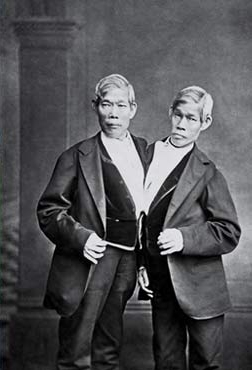
Eventually, as the twins grew older and became more aware of the business they were in, they realized that their manager Coffin (who had bought out Hunter at this point) was taking most of their money. At the age of twenty-one, when they legally became adults, they broke off their connection with him and hooked up with the legend of sideshows, the Shakespeare of advertising, the sleazeball of the century, Mr. PT Barnum. Despite their fame and popularity, Barnum was never overly affectionate towards the twins in the same way he was with his other major successes like Tom Thumb and Joyce Heth. The twins didn’t care much for Barnum either, so they went their separate ways. The twins began touring under their own management, and that suited them just fine, having been burned by shady managers before. They toured for a few years like this, even going to Europe, but life on the road proved tiring for the almost thirty year old twins, so they decided to settle down.
In 1839, Chang and Eng decided to settle in Wilkesboro, a small town in North Carolina. With the money they had made from performing, they bought a 110 acre farm and started life as farmers. They also became American citizens that year and formally adopted the last name “Bunker” as their own. Chang and Eng began dating in this period of their life, courting two young Quaker sisters, Adelaide and Sarah Ann. The townsfolk objected to this union, not only because of the young men’s deformity, but also because they were Asian. Despite objections from racists and bigots, Chang married Adelaide and Eng married Sarah Ann in a double wedding in 1843.
Chang and Eng proved to be very fruitful men, fathering twenty-two children between them. In the 1850s, the twins started touring again to be able to afford to educate all of their children well. As their families grew bigger, it became evident that no one house would be able to hold all of their children. With this in mind, they built two houses on their property and split their time evenly between them, alternating every three days. Nothing was significant enough to break the three day rule, not sickness, injury, nor even the death of a child. Another problem arose in Chang and Eng’s life in the 1860s, namely the Civil War. Being wealthy, slave owning southerners, Chang and Eng were on the side of the Confederacy. This fact proved financially troubling for them, as the freeing of slaves at the end of the war left them with a greatly diminished labor force. The economic hardships forced the twins to once again work with Barnum in order to support their enormous family. They once again toured England and other parts of Europe.
On their way back from their tour of Europe, Chang suffered a stroke, partially paralyzing him and imposing a great strain on Eng to support him. Chang became deeply depressed after this and took to drinking, and from there his health only deteriorated further. Chang passed away first, with Eng following shortly after, on January 17th, 1874. It is unknown whether or not Chang and Eng could’ve been separated by today’s modern medicine, but with medical technology as it was then, separation attempts likely would’ve killed them.
Chang and Eng lived to be 63, an age unprecedented for conjoined twins to live at the time. Their descendants are numerous, and their legacy is perhaps one of the most persistent of any sideshow performers. They went from living on a fishing boat in Siam to being internationally famous. They met royalty, they were banned from France, they fathered twenty-two children and were married to white women, an incredible feat in the 19th century for Asian men. Truly they are some of the most incredible twins to walk the earth and their legacy should be more than a colloquialism people don’t know the origins of.
That was the biography of Chang and Eng. I got much of my information on these twins from the fantastic book Very Special People by Frederick Drimmer. It is a great read for those interested in a deep dive on a variety of performers. Catch you readers next week.
 Prodigies! A Sideshow History Blog
It’s so strange that PT Barnum didn’t like Chang and Eng, considering their success. This was very interesting.
LikeLike
Part of the reason Barnum didn’t like Chang and Eng is that they didn’t like him. They had a problem with managers. They were very independent people and resented being managed in any capacity.
LikeLike